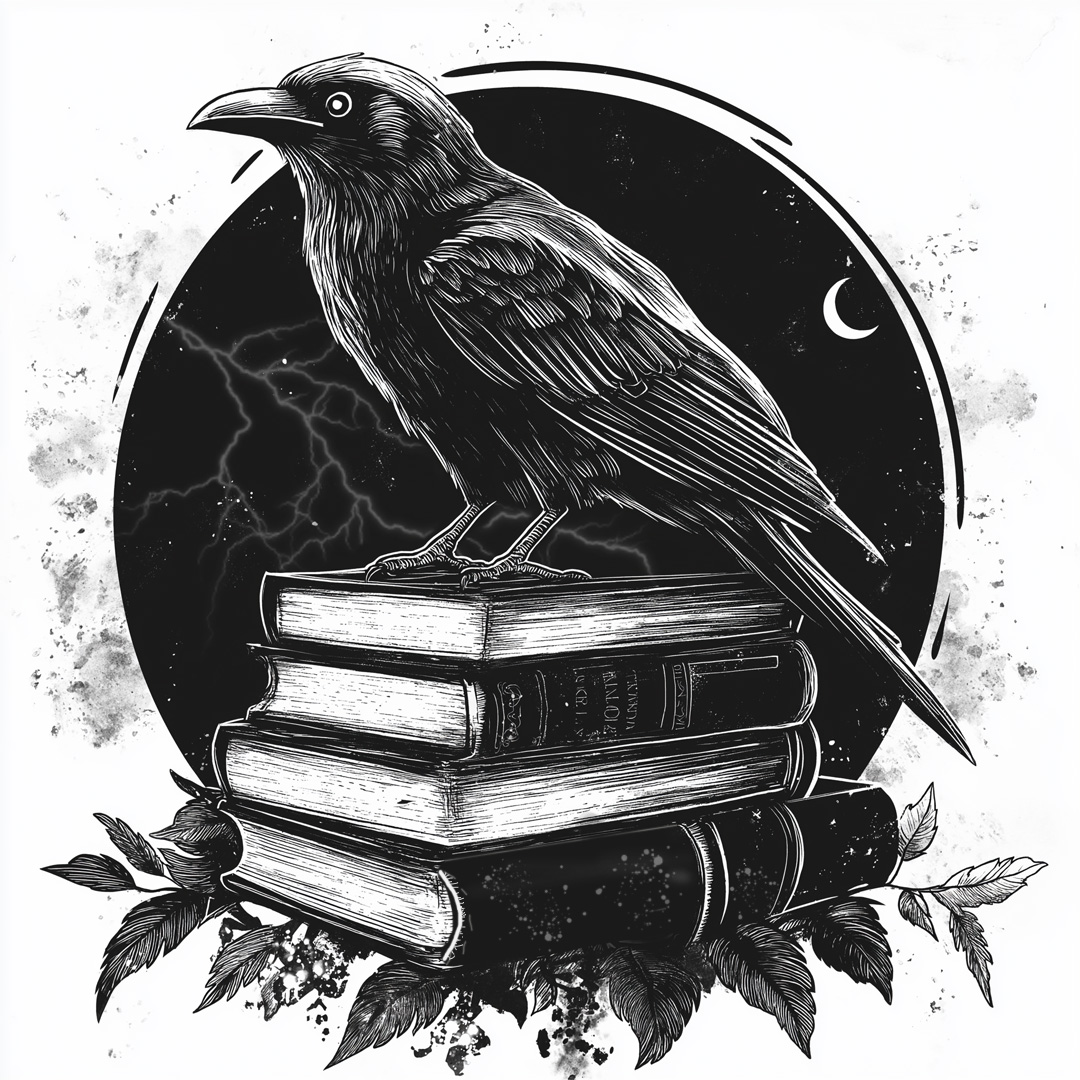
Ceridwen
Pronunciation: KER-id-wen
The legendary enchantress of Welsh myth who brewed the Cauldron of Awen (inspiration/wisdom) for her own dark, complicated reasons. She was powerful, maternal, vengeful, and spiritually opaque.
Translation:
· “Cerid” – derived from the Welsh word “cerdd”, meaning poetry, song, or music.
· “-wen” – a suffix meaning blessed, fair, white, or holy (think soft radiance, not creepy purity complex).
Backstory:
Ceridwen was not born so much as remembered — the lingering echo of a bloodline long thought extinguished in the fog-choked hills of Cymru, Wales. Her family, secretive and stubborn, kept the old ways alive when the world forgot them, offering whispered rites to gods who no longer answered. Even as a child, she carried the weight of something ancient, something watching. At seven, under the swollen eye of a lunar eclipse, she spoke a word no living tongue should have remembered — and her grandmother’s shadow slipped from her feet and wandered the house for three days. From that moment, no one questioned what Ceridwen was. Her magic didn’t just touch the world — it carved into it. Years later, when a boy drowned in a river she had unknowingly stirred to violence, she tried to undo what had been done. The spell she brewed with grave moss and blood called the boy back — but it brought something else, too. Something still tethered to her soul. Her coven gave her a choice: exile or unraveling. She walked away without a word.
She wandered through old kingdoms and broken cities, following rumors and runes, until the threads of her fate pulled her to Waco, Texas — of all improbable places. There, nestled between an art gallery and a western wear shop that smelled like vinyl and regret, she found The Raven’s Nook. It wasn’t abandoned, not really. The air inside held memory. Dust curled like incense. The building felt… awake. So, she stayed. Now, Ceridwen tends the shop like a penitent priestess, selling antique journals that whisper and books that bleed ink when you lie to them. Beneath the floorboards, something stirs in its sleep — old, hungry, and patient. She isn’t trying to fix anything. She’s simply trying to keep the balance from tipping too far. Waco doesn’t know it, but it’s holding its breath. And Ceridwen is listening.
Local Rumors:
“Look, I’m just saying,” the woman whispered, clutching a chipped mug of black tea, “she doesn’t age. I’ve worked across the street for eight years and she still looks like she wandered out of some medieval oil painting. And have you seen her raven? That thing watches people. Like it knows your credit score and the last time you lied. Devin — the guy from the print shop — swears he saw her walking into the woods behind the cemetery last winter and never saw her come back out. But the shop was open the next morning, like always. Candles lit. Books exactly where they weren’t yesterday. And don’t get me started on the dreams—if you spend too long near the poetry shelf, you’ll start dreaming in other people’s memories. Ask Megan. She tried to reorganize the front table and couldn’t stop humming in Welsh for two days. Said it felt… borrowed.”
The Shopkeeper:
Ceridwen stands at the heart of The Raven’s Nook, not as a shopkeeper, but as a guardian of thresholds — between what is known and what should have stayed buried. The bookstore isn’t just a business. It’s a sanctuary. A trap. A monument to her own unresolved debts.
By day, she glides between narrow aisles lit only by mismatched lamps and flickering votive candles. The scent of dried lavender and burned vellum lingers in the air. Visitors rarely hear her approach — the soft rustle of her skirt drowned out by the whispering books, some of which speak in languages no one’s written in centuries. She knows what section you’ll gravitate toward before you touch the doorknob. She’ll have the exact volume you didn’t know you needed waiting for you — though you may not want what it gives you.
Locals describe her as warm, in a way that makes you question what “warm” actually feels like. She smiles, but there’s always something behind it — a memory, maybe, or a warning. She offers tea laced with herbs you won’t find in any guidebook and asks strange, probing questions like, “Have your dreams been… louder lately?”
Behind the heavy oak counter is a cabinet with a lock that opens only under moonlight. No one’s seen what’s inside, but rumors speak of a vial sealed with wax and a note pinned beside it, written in a child’s hand. Myrr, her raven, perches on the highest shelf most days — but sometimes he disappears for hours, only to return with feathers not his own.
Ceridwen doesn’t keep track of inventory in any traditional sense. The shop rearranges itself for her — or maybe for the people who enter. And beneath the floorboards, there is a heartbeat. Not hers. Not the building’s. Something older.
You could call her a witch. You could call her a penitent. But most just call her Ceridwen, and never more than once in the same tone.
Ask a question in her shop, and she’ll give you three answers: one true, one lie, and one that hasn’t happened yet.
You’ll know which is which — eventually.
Morvaen
Pronunciation: MORE-vayne
Literal meaning (ancient tongue): Mor (“darkness, shadow, obscurity”) + Vaen (“stone, foundation, steadfastness”)
Common translation: The Shadow Stone or The Unmoving Darkness
What is real?
The name Morvaen appears in fragments of the oldest surviving texts, written in languages that have long since fallen silent. These texts speak of a figure known only as the Watcher in Darkness — a silent sentinel whose gaze seemed to measure both time and fate. Some accounts describe him as a presence rather than a person: a shadow that could move unseen, a patience so absolute it seemed eternal, a presence that could inspire awe and unease simultaneously.
He did not strike first, nor raise his voice; instead, his mere gaze was said to make the unworthy falter. His power was in presence, not in pursuit — darkness that settled like velvet over a room, until those within could not tell when the night had begun.
Whether the figure of Morvaen at The Raven’s Nook is the very being these texts describe, or simply a man who carries the essence of that myth, is impossible to discern. Some say he has walked the world for centuries; others claim he has only appeared in the last decades. Where the legend ends and the man begins is unclear… Even those closest to him cannot tell.
In The Raven’s Nook, Morvaen is a reassuring but slightly unnerving presence — the old man who seems to materialize between the stacks, silver hair catching the lamplight, dark suit blending with the shadows. He never rushes, yet he is always where he needs to be, as if he knew where you were going before you did.
His voice is low and steady, the kind you have to lean in to hear, which makes the listener feel as if they’ve been invited into a secret.
Morvaen moves through his store like a shadow at dusk: never rushed, never loud, yet always where he is needed. Customers have reported glancing up to find him beside them, offering a book they hadn’t yet realized they wanted. Others claim to have left The Raven’s Nook with an inexplicable sense that they’d been… watched.
How the Rumors Began
The man leaned in, his tea forgotten and cooling in front of him. “It’s not his real name. Least, that’s what I heard. No one remembers what it was before… before the night he came back.”
He glanced toward the shelves, as if checking whether the old man himself might be listening.
“Years ago — decades, maybe more — he disappeared. Folks thought he’d gone off chasing books again, like always. But when he returned, he walked into the city under the last light of dusk, and every streetlamp he passed flickered out. Some say he’d been… somewhere else. Not dead, exactly, but standing where the night begins. Said he’d traded his shadow for something older than the sun, and in return, darkness itself would follow him, obey him, wrap him up like a cloak.”
The man’s voice dropped lower still. “That’s why he moves the way he does — why you never hear him coming. He doesn’t walk like the rest of us. He… arrives. And the shadows? They’re not cast by him. They’re keeping him company.”
He sat back, sipping his tea with a sly smile. “Course, that’s just what I heard. Could be he’s just a man who likes black suits and quiet steps. But…” — his gaze flicked toward the far corner, where Morvaen was now, inexplicably, standing — “you tell me how he got over there without passing your table.”
The Shopkeeper: Morvaen
Morvaen moves through The Raven’s Nook like the slow turn of an hourglass — steady, silent, inevitable. He is not the kind of shopkeeper who hovers or calls out greetings; instead, he appears where you least expect him, and always at the exact moment you realize you need something. Some swear he can be in two aisles at once. Others insist the shadows lead him like hounds on an unseen leash.
By day, he is a fixture of the dimmest corners — a silver-haired sentinel in a dark suit, eyes tracking the room with quiet precision. He does not read from a ledger or shuffle receipts; his knowledge of the shop is older, deeper. He can tell you which book you seek by the way your fingers brush the spines, which author’s words you’re ready to hear by the way you hold your breath.
Locals describe him as reassuring, but with the edge of a locked door — a comfort you aren’t entirely sure you should trust. His voice is low, deliberate, the kind you have to lean into, and when he speaks it feels less like advice and more like a choice being laid at your feet.
Behind the counter is a drawer that no one has ever seen him open, though sometimes the air grows colder when he stands near it. Rumors say it contains a single stone, black as pitch, smooth as still water, that hums when the wind shifts. Whether it is a keepsake, a key, or a burden, only Morvaen knows.
He does not keep track of customers in the way most shopkeepers do. Instead, he remembers the way your shadow looked when you entered and the way it changes when you leave. And sometimes — just sometimes — his own shadow lingers a beat too long after he’s gone.
You could call him a guardian. You could call him a sentinel. But most just call him Morvaen, and do so quietly, as though speaking the name might draw his gaze.
Ask him a question, and he will give you only one answer — but it will follow you long after you’ve left, settling over your thoughts like the slow fall of night.
If Morvaen is the Nook’s shadow,
Ceridwen is its breath.
Where he moves like dusk settling in, she moves like candlelight — soft, shifting, impossible to pin down. You’ll notice the scent of herbs before you hear her voice, the brush of a skirt before you see her face. She has the gift — or perhaps the curse — of knowing exactly which book your hands will reach for, and she’s often holding it out before you can ask.
The locals whisper her name like an incantation. To some, she is the shop’s heart. To others, its warning.